Mold on ham: Why? What is it?
- Production, Tips and Tricks
Indice
Mold on Ham: A Sign of Traditional Curing
Why does mold appear on our ham? Should we be worried? How to remove it and, most importantly, how to prevent its reappearance? At jamonibericodebellota.com, we understand that the presence of mold on a ham can raise doubts. However, far from being a problem, this natural phenomenon is often an indicator of slow, natural, and traditional curing—a seal of quality that speaks of the care and attention dedicated to each piece.
Demystifying Mold on Ibérico Ham
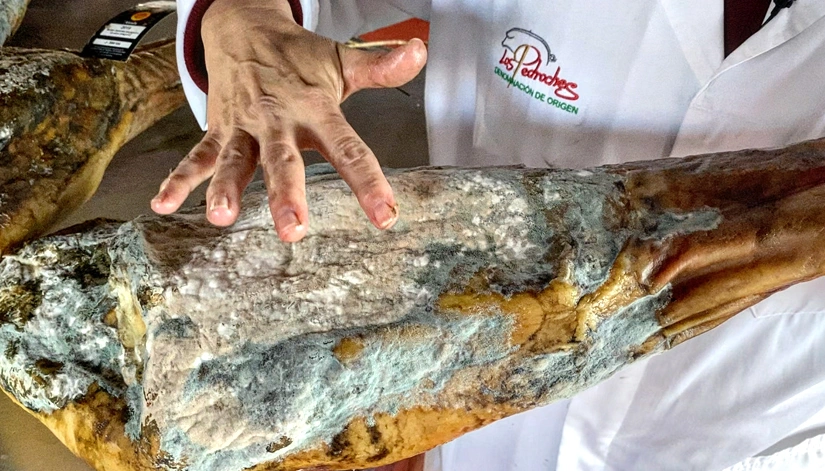
Have you ever encountered a thin layer of mold on the surface of your prized ham? Don’t worry, there’s no cause for alarm. This mantle, often whitish or greenish, is a key player in the maturation of a quality Ibérico ham.
Why does my ham develop mold?
Various factors can lead to the appearance of mold on ham:
- Prolonged wrapping: A ham newly arrived at home needs to breathe. Keeping it wrapped in greaseproof paper and a sleeve for too long can favor humidity and, consequently, the appearance of mold.
- Humid environment: An environment with high humidity is an ideal breeding ground for fungi.
- The curing process itself: In many cases, the presence of mold is an intrinsic and beneficial part of the ham’s natural curing process.
Mold on Ham: Friend or Foe?
Definitely a friend! During slow curing, the surface mold acts as a natural fat stabilizer, contributing to a healthier and more authentic maturation process. This mold, generally superficial, does not penetrate the interior of the piece nor does it pose any risk to our health. In fact, its presence is a sign of artisanal and prolonged curing.
Removing mold: a simple process
While mold is not harmful, we understand that its appearance may not be the most appetizing. Removing it is very easy:
- Dampen a clean cloth (preferably lint-free) with a little olive oil.
- Gently wipe the areas where the mold is found until it completely disappears.
Prevention: the key to an impeccable ham
Once clean, the goal is to prevent the mold from reappearing. Here are some essential tips:
- Proper storage: Store your ham in a dry, dark place, away from direct sunlight and sources of humidity. A ham cover or even the ham’s own fat can be excellent allies.
- Strategic cutting: Try to open the ham on only one side. Minimizing the exposed surface reduces the chances of fungi proliferating.
- Natural protection: Save some pieces of the ham’s initial fat and use them to cover the cut surface after each use. This fatty layer acts as a natural protective barrier without altering the flavor. Then cover with a clean cotton cloth.
- Hanging for optimal preservation: If you are not going to consume the ham immediately, keeping it hanging favors better aeration and preservation.
The Language of Mold: Colors that Speak of Curing
Interestingly, the type of mold that appears on the ham and its coloration can offer clues about the curing phase:
During post-salting or settling, it is common to find molds of the *Penicillium* genus, which thrive in low temperatures and high water activity. These usually appear with a whitish color and adhere to the lean part.
In the drying phase, with the gradual increase in temperature, *Aspergillus* strains may appear, manifesting with a green color and a velvety texture. Both *Penicillium* and *Aspergillus* are the most common mold genera in cured ham cellars, although others may exist. Their presence, although visually it may not be the most attractive, plays a fundamental role in the development of the unique texture and flavor of Ibérico ham.
At jamonibericodebellota.com, we value every stage of the curing process, and the presence of mold is often a confirmation that we are following traditional methods that guarantee the excellence of our hams. So, the next time you see that subtle mantle on your ham, remember: it is a sign of authenticity and flavor.
Mold on Ham: Normality, Prevention, and Cleaning
The appearance of mold on the surface of the ham (Serrano or Ibérico) is a completely natural phenomenon and a sign that it has followed a traditional curing process, according to experts from Ibéricos Casa Lucas. This mold is superficial and does not affect the interior of the piece, meaning it does not pose a health risk under normal conditions. Only if mold appears inside the slices or is accompanied by an unpleasant odor should the product be discarded.
To prevent its appearance, it is essential to store the ham in a cool, dry place away from sources of humidity. The main trick to protect the cutting area is to cover it with a piece of the fat removed from the piece, which acts as a natural barrier. If you don’t have this, you can use plastic film or a clean cotton cloth. It is also advisable to open the piece on only one side to minimize the exposed surface.
If mold is detected, there is no need to panic. The recommended cleaning method is simple: dampen a clean cloth in vegetable oil (olive or sunflower) and gently rub the affected area, avoiding the use of water or soaps. If the mold is on the exposed meat, a layer approximately one finger thick should be cut off to eliminate any trace. As long as the color, odor, and texture remain normal, consumption after cleaning is safe. It is recommended to consume the ham within one month after opening.
Preservation of Vacuum-Sealed Ibérico Ham for Longer Duration
The preservation of Ibérico ham is crucial to maintain its organoleptic qualities, and vacuum-sealing is presented as the most effective method to significantly prolong its shelf life. This process is ideal for ham lovers who wish to have the product available in its best condition for a considerable time.
The main advantage of vacuum-sealed ham lies in the elimination of oxygen from its environment. Oxygen is the main catalyst for food degradation and deterioration, as it promotes oxidation and the growth of microorganisms. By eliminating it, vacuum-sealing considerably delays these processes, managing to preserve the ham’s quality, flavor, and properties for a longer period.
Generally, vacuum-sealed ham can last between 3 to 6 months unopened, maintaining all its properties intact. It is important, however, to always verify the expiration date provided by the manufacturer and consider the storage conditions.
Preservation After Opening
Once the vacuum-sealed ham package is opened, exposure to air necessitates accelerating its consumption. To ensure its freshness and flavor, it is recommended to consume the ham within 2 to 4 weeks after opening.
For the preservation of already opened slices:
- Wrapping: It is essential to wrap the leftover ham in plastic wrap (film) immediately.
- Storage: Store it in an airtight container and return it to the refrigerator.
- Objective: The main objective is to avoid direct contact with the air to prevent oxidation and the possible formation of mold.
Alternative for Whole Pieces
For whole ham pieces stored at room temperature, a simple trick to extend their shelf life is to cover the cutting area with a simple plastic film. This film, by acting as a barrier against oxygen, will make a significant difference in preservation. An additional trick is to cover the plastic film with the ham’s own fat, which helps create a natural protective layer that keeps the piece in perfect condition.
In summary, while covering the ham with film and its own fat is a good trick for whole pieces, vacuum-sealing is the most advanced and effective technique to ensure that the ham, especially sliced ham, maintains its quality and flavor optimally for months.
Nota importante: aceitedelcampo.com promueve el consumo del aceite de oliva virgen extra por sus cualidades culinarias y beneficios para la salud. No obstante, no debe sustituirse ningún medicamento o tratamiento actual sin la orientación de un profesional de la salud.
Productos que te pueden interesar
140,00 € – 160,00 €Price range: 140,00 € through 160,00 €
145,00 € – 165,00 €Price range: 145,00 € through 165,00 €